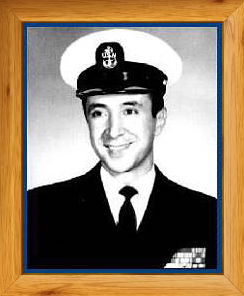
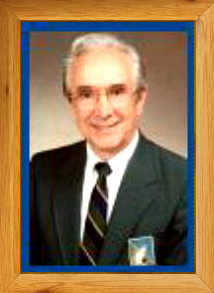
Dr. Frank Biasco
Dr. Frank Biasco served on the USAT Edmund B Alexander and the USAT Pomona Victory. He was a Radarman assigned to the Armed Guard. Frank passed away recently
Picture Below: Frank Biasco as a Radarman 1/C
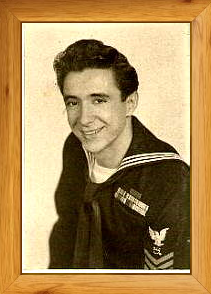
Picture Below: Frank Biasco as a Chief Petty Officer
Picture Below: Frank Biasco in a recent picture
I joined the United States Navy on my 17th birthday, January 15, 1945
during World War II. That means I dropped out of high school so that I
could serve in the Navy at the earliest opportunity.
After completing my “boot camp” at Great Lakes, Illinois, I was sent
to Radar School at Point Loma, California for training as a “Radarman”.
Since the war in Europe had ended with “V.E. Day”, the expectation was
that we all would be sent into the raging wars which were taking place
in the Pacific Theatre War.
Quite unexpectantly, I was sent to the East Coast and assigned to the
“Armed Guard”. Very few people these days will know what the Armed Guard
stood for or what it did. In fact, the Armed Guard consisted of Navy
Personnel assigned to merchant ships. Actually, they were U.S. Army
ships. So, we would brag about the fact that we were assigned to Army
ships run by merchant crews. The name Armed Guard came from the military
mission that most personnel who were assigned to the merchant ships had;
namely, operating the guns to ward off enemy submarines. Since radar was
relatively new in those days and since the Armed Guard was the only
established unit working on the merchant ships, it was only logical that
I be assigned to the Armed Guard even though I had nothing to do with
manning the guns. My job was to operate the radar which had been placed
on troop transports. The expectation was that if and when the troop
transports had to break convoy formation, that it would at least have
it’s own radar and it’s own radarmen to conduct radar operations.
After World War II ended, I was transferred to the Pacific destroyer
fleet. I was assigned to one of the two last destroyers being built, the
U.S.S. Lloyd Thomas. As such, I was one of the “plank owners”, which
means that I was one of the original crew and was part owner of the
ship. After the ship was launched, it joined the aircraft carrier Valley
Forge and toured the world with the carrier. Unfortunately, I was
detached from the Lloyd Thomas and assigned to the destroyer picket
ship, Newman K. Perry, U.S.S. 933. The Perry, along with other ships in
the eight ships flotilla, sailed to China where we spent nine months
sailing up and down the China coast while based in Tsintao, China. We
sailed to China in September 1947 and returned to the United States in
May 1948, one year before the Communist Chinese took over the mainland.
Shortly after returning to the United States I was discharged from my
first tour of duty at the age of 20 and 1/2 years and with the rank of
1st Class Petty Officer (Radarman).
Korean Conflict
In July of 1950 the North Koreans invaded South Korea and I was
recalled to active duty at the age of 22. I was ordered to Great Lakes
Naval Station and from there was flown by civilian transportation to
California. From there I expected to be flown directly to Korea. But
instead I was assigned to the Amphibious Forces and attached to an
attack transport, the U.S.S. Montrose (APA 212). Unfortunately, the
Montrose was in the “mothball” fleet and had to be resurrected.
Activating the ship took several months and we were not ready to set
sail until late December of 1950. The trip to Yokosuka, Japan took about
14 days with a stopover in Hawaii for a couple of days.
Our first assignment was to take the ship to Pusan, Korea where we
were to load troops and make a landing at Inchon, Korea. Unfortunately,
there were no troops available. Instead, a convoy of eight attack
transports like the Montrose, set sail for Inchon even though we had no
troops with which to conduct an assault landing. The plan was for the
ship’s boats to be lowered with make-believe assault forces which
actually consisted of the ship’s crew. The crew was to disembark on one
side of the ship and embark on the other side of the ship with the shore
forces being lead to think that we had multiple troops to send ashore.
Since duty aboard the Montrose seemed rather dull for a 1st Class
Radarman, I requested and received assignment to the Navy’s Command
ship, the U.S.S. El Dorado (AGC 12) and became the senior radarman
aboard that ship. The way I got to that ship is a story in itself.
First, I was detached from the Montrose and given temporary housing on a
Landing Ship Transport (LST) in Yokosuka Bay until such time as
transportation could be arranged for me. All I can remember about that
short stay of about a week was that I was never comfortably warm and
never had anything to do. When my transportation was finally arranged I
was driven to Tokyo with several days of packed lunches and given
tickets for the renown Japanese trains. It took me about two days to
travel from Tokyo to Sasebo, Japan where the U.S. Navy has another base.
From there I was placed on a Japanese ship and sent to Pusan, Korea with
another packed lunch. Since Pusan is only across the Yellow River from
Sasebo, it was only an overnight ride to Pusan. Most of the personnel
aboard that Japanese ship called the MARU were army. I believe I was the
only Navy man aboard except for the Japanese crew. That trip introduced
me to the Japanese toilet plumbing system and the sleeping arrangements
which essentually was a coiled up mat which permitted you to sleep
anywhere you wanted like on the open deck. By the time I finished my
sandwhich and apples that the Navy had packed for me we were in Pusan.
Again I had to wait for my ship, the U.S.S. El Dorado to arrive and so I
was placed again on another LST, but one which was better maintained and
a great deal more comfortable. In a week or so the El Dorado appeared
and I was transferred to it to assume my new role as the leading
radarman aboard that ship.
While the ship was in port, we were asked if we wished to take
positions on the front line against North Korea while the ground forces
came aboard ship and experienced clean living and good food for a
change. I volunteered and was given a carbine rifle, a field jacket and
a helmet and assigned to a Puerto Rican regiment in the Army’s Third
Division. Not surprisingly, the troops in that regiment thought I could
speak Spanish, which I could not. But since Italian is close to Spanish,
I seemed to understand most of what was said. In addition, many of the
troops thought I was in the Army even though I had a battleship gray
helmet and my three stripes were inverted to reflect a First Class Petty
Officer. But as we talked, things were clarified and better understood.
We did not engage in any actual combat because when I reached this
regiment, they were ordered to go to the rear and rest up while in
reserve. So this entire experience, while interesting, was without much
excitement.