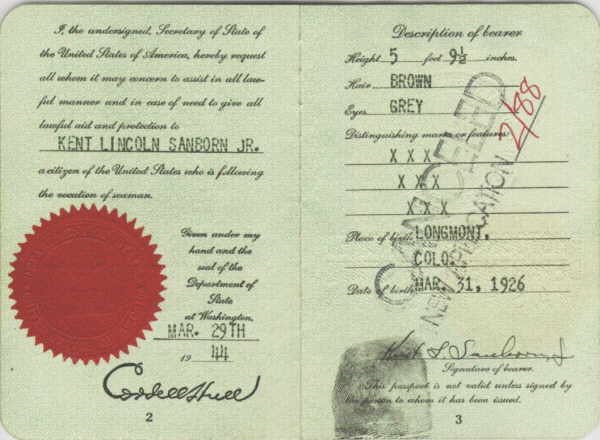
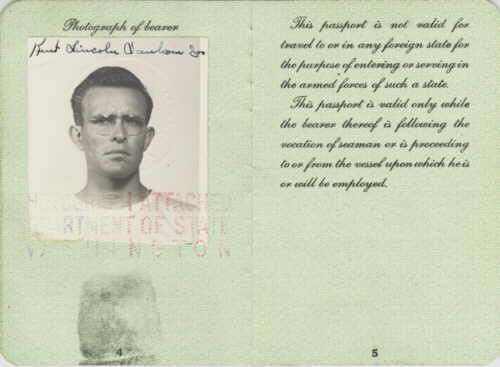
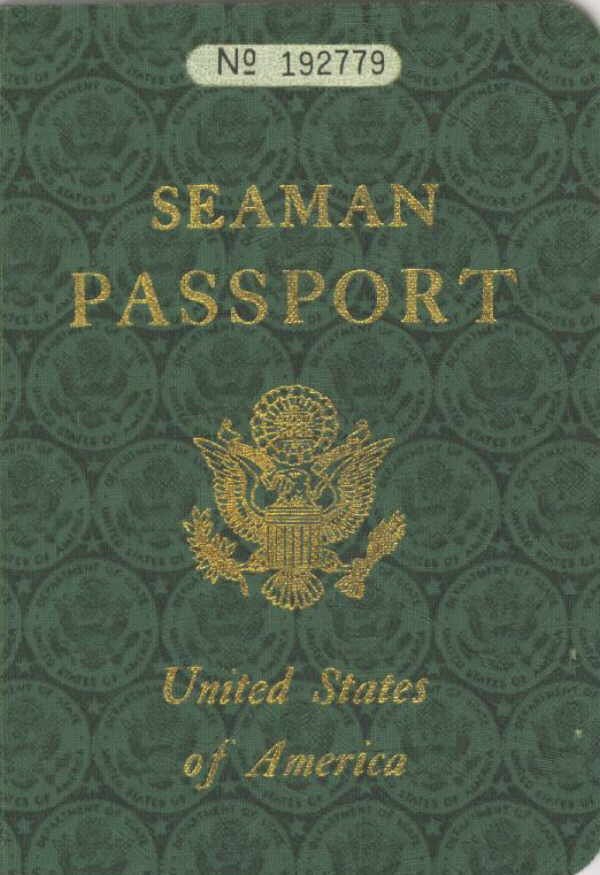
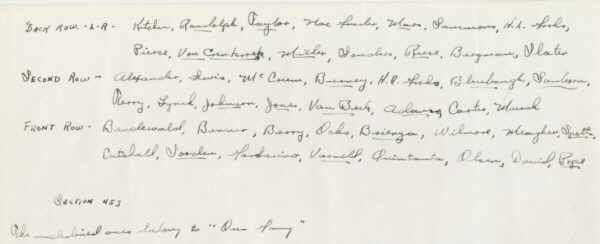
Kent Sanborn:
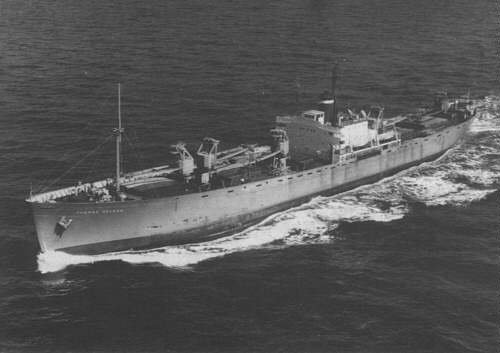
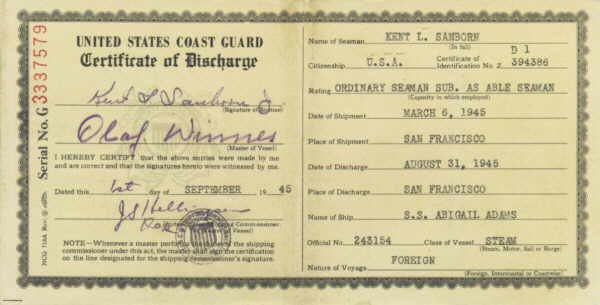
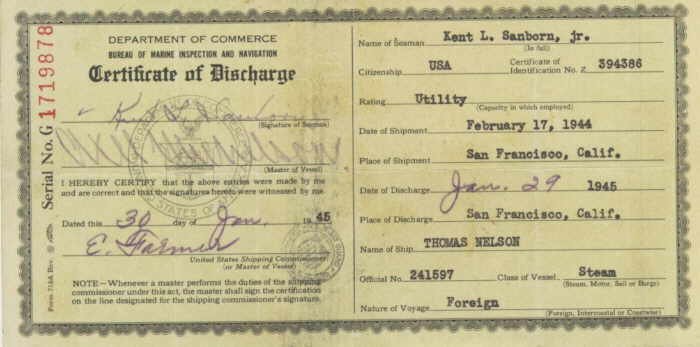
I was a member of the crew of SS Thomas Nelson from February 17, 1944 to January 29, 1945. The Nelson was a Liberty ship in the US Merchant Marine and was operated for the government by a division of the W.R. Grace Company. She was hull number 30 of some 2750 Liberty’s built during the early part of World War II, and was unusual in that she was all riveted rather than welded like most later ships of that design. Her port of registry was Baltimore but she was operating in the Pacific in 1944. We sailed out of San Francisco with a cargo of mixed supplies destined for use by army units in New Guinea. After a thirty day crossing we made our first stop in Milne Bay. The next several months were spent ferrying supplies and equipment along the New Guinea coast all the way from Port Moresby to Biak and nearly every place between.
In October of that year we loaded some of the troops and equipment of the Army Air Force’s 345th Bomb Group at Biak and proceeded to Hollandia, New Guinea. There we joined a convoy that was scheduled to be part of the Philippine Island invasion force. That trip into Leyte Gulf turned out to be the last shuttle for the Nelson that year due to damage sustained in a Kamikaze attack while at anchor near the town of Dulag on the island of Leyte.
My recollection is that the harbor at Hollandia was pretty well filled with ships. Some were Navy fighting vessels, but most were merchant ships like ours. I remember the night before our departure as being very dark. We watched masthead lights on the warships flash rapidly for a couple of hours as signalmen talked with each other in a steady stream of coded messages. Sometime after midnight I stood on our flying bridge with the ship’s Second Mate and watched as the Navy pulled out, ghosting past us almost without a sound. I remember wondering at the time how it was possible to go through all the commotion of hoisting anchors on several large ships and stowing them away in nearly total silence. By dawn they were gone.
The trip to Leyte was slow. All trips on Liberty ships were slow. For the Thomas Nelson, ten knots was a pretty normal speed when she was traveling alone. Convoys were usually a bit slower than the slowest ships. Without knowing, I imagine the same was true of formation flying where maintaining position and maneuvering requirements might limit the flexibility a pilot has when he’s alone. I don’t remember how many days it took us to get there, but the trip was uneventful. Some might even characterize it as boring with pleasant weather, bright skies, a gentle rolling motion and time spent lolling against the rail watching the flying fish do their thing.
When we arrived in Leyte Gulf on October 29, 1944, some of the convoy anchored near Dulag. I don’t remember whether all did or not, but we did, and so did SS Morrison R. Waite on which some other 345th people had made the trip. For reasons I don’t know about, the Army wasn’t ready to accommodate the 345th on shore immediately. One story I remember hearing was that the airstrip wasn’t ready to accept their airplanes. Maybe someone else can shed more light on that. For whatever reason, they stayed on the two ships for several days. During that time we knew there were air raids around because we could see and hear the anti-aircraft artillery, but none of it seemed particularly threatening to me. The targets seemed to be on the beach a little north of our location, closer to the town of Tacloban. In those days I was barely eighteen years old and, like Alfred E. Newman of “Mad” magazine fame, subscribed to the philosophy “What? Me worry?” I was too ignorant to be frightened. All of that changed abruptly at lunch time on November 12, 1944.
I was standing in the starboard companionway of the main deck house, just inside the forward doorway onto the main deck, when a fierce explosion knocked me to my knees. One of the ship’s cooks was there with me and both of us needed several seconds to recover from our initial shock. When we went outside to see what had happened, we looked first toward the foredeck, which was nearest to where we stood. We couldn’t see anything there that would account for the explosion so we ran aft along the outside companionway. As soon as we cleared the end of the deck house, we stood near the head of the temporary ladder into the number four hold where many of the 345th people were quartered. From there we could see a major fire in the aft end of the ship. I recall that the worst of the fire was on the port side and a little aft of the mast between the fourth and fifth holds. I also recall the feeling of alarm that struck me when I realized I couldn’t see the after deck house where our Navy gun crew people were quartered and where there were magazines full of ammunition for a four-inch surface gun and two twenty millimeter machine guns. There was absolute pandemonium for a few minutes, but at the time it seemed like hours.
When I finally “got my wits about me” I went to a nearby fire hose location. There were already people there trying to get the hose, which had been damaged, into service, so I went up the ladder onto the boat deck to get another hose. With help from somebody nearby the hose was pulled out, but when the valve was opened we found that the hydrant had been destroyed by shrapnel. It was quickly decided that any useful hoses had to be fed from hydrants inside or forward of the deck house. Several people got that done after what seemed like an eternity. I have no idea how long it took to get water on the fire. It was probably not more than ten minutes or so, but that ten minutes seemed like forever. After the fire had been knocked down I went aft to my battle station in the four-inch gun tub and spent the rest of the afternoon unloading magazines and throwing overheated ammunition overboard.
As we moved around the deck that day, we could see a lot of people who had been killed or very seriously wounded. We could also see people in the water alongside the ship. Some may have been blown overboard. Others, including a gunners mate from our Navy gun crew, probably jumped to escape the fire. Sometime during the early afternoon we began to see small boats coming out from the beach in an effort to help. In Tom Brokaw’s book, “The Greatest Generation”, he tells about one of those people, John Assenzio, who was awarded the Bronze Star for his lifesaving efforts.
Eventually I looked around the anchorage at the other ships and saw that the Morrison Waite had also been hit. It appeared to me that the damage to that ship was worse than what we had on the Nelson. The airplane that hit us appeared to have struck the rigging near the masthead aft of the main deck house. Most of the airplane went into the water and the fire with which we had to deal was burning fuel from his ruptured tanks. On the Waite it appeared the airplane had hit the side of the ship below the rail and just aft of the starboard anchor hawspipe, opening a large triangular hole into the number one hold. However, we were anchored some distance apart so that impression may not be accurate. In any event, both ships sustained significant damage and the human loss was indescribable. I had never seen mayhem like that. It was unnerving and ugly. The memory still brings tears to my eyes and I know it will be with me for the rest of my life.
I never heard how many 345th people were lost that day. Of our crew, two of the fourteen man Navy gun crew were killed and two were taken ashore wounded. I never saw them again. Probably because it was lunch time and people were inside the deck house preparing to eat when the plane exploded, none of the 35 merchant seamen were killed. Only two had relatively minor wounds. After the raid the Army moved quickly to get their people ashore. I think all of them had gotten off our ship by nightfall that day. Following that, the supplies and equipment were unloaded with priority given to things needed most as determined by the Army’s port commander. It took two or three days to get most of it ashore. In our lower holds we had bombs which were not high on anyone’s want list, so we sat there for a few more days. Eventually we moved the ship closer to Tacloban where we waited again for someone to want those bombs. It was probably about a week after we dropped anchor at Tacloban that we joined a southbound convoy.
It seems to me that Mother Nature has a wonderful way of softening the effect of catastrophic events for us. I’m glad because it would be hard to go on sometimes if that didn’t happen. I’ll never forget that day in Leyte Gulf. But more importantly I’ll always remember the time I had with 345th after we left New Guinea and before we met with disaster. I met some fine people and have felt a strong affinity with them ever since.
Kent Sanborn June, 1999